The journey
Four moments, from the invitation to the insight.
One link to your stakeholdersStakeholders are the key groups within an organization’s orbit:Employees & Managers; Customers; Vendors & Service Providers; Investors & Donors; Candidates.. A clear reading of the organization in return.
What comes out of it
A score, the gaps behind it, and what to do on Monday.
The score
69.3/100
Organizational type
Natural
Organizational Culture80
Core Components74
Processes56
Results from a completed assessment. The organization is not named.
The five widest gaps
Important to your peopleHow it actually feels
Salary and benefits2.0
Training and courses1.9
Social life and team events1.4
Pension and insurance plans1.3
Opportunities for promotion1.0
10 to 12 domains measured, for every stakeholder group.
A high gap is an important need going unmet.
Tomorrow morning
The report ends in things you can put in a calendar this week, and in a new language for what happens between people here.
01
Processes
Run an orientation week for every new joiner
New people currently spend their first month working out who to ask. A fixed orientation, with the same sessions every time, replaces that guessing with a map of the place and the people in it.
02
Processes
Publish the promotion criteria before the round, not after
Today the decision is announced once it has already been made, which reads as arbitrary even when it is not. Naming the criteria and the timeline in advance turns the same decision into a fair one.
03
Culture
Retire “Generation A” and “Generation B”
The labels quietly sort people into real and provisional. “Founding team” and “Growing team” describe the same two groups without putting one of them on probation.
04
Culture
One shared table a week
Belonging is not built in meetings. A standing Thursday lunch in the courtyard, bring your own food, does more for familiarity than a yearly offsite.
05
Core Components
Name the value behind the decision, out loud
Values on a wall change nothing. Saying which value a decision served, in the meeting where it is made, is what turns a stated value into a working one.
06
Core Components
Add one line to every decision: how will this land?
Organizations already ask what a decision costs and how long it takes. Adding a third question, in the same meeting, in the same template, is the cheapest way to make emotional intelligence part of how the place decides rather than how it apologises afterwards.
Almost none of this costs money. Changing the words you use costs awareness and a decision, nothing else. Small enough to start on a Monday, and once they hold they stop feeling like an initiative and start being the way the organization works.
Illustrative examples. Every report carries the actions that follow from that organization’s own results.
What’s Your OEI Type?Your OEI workspace
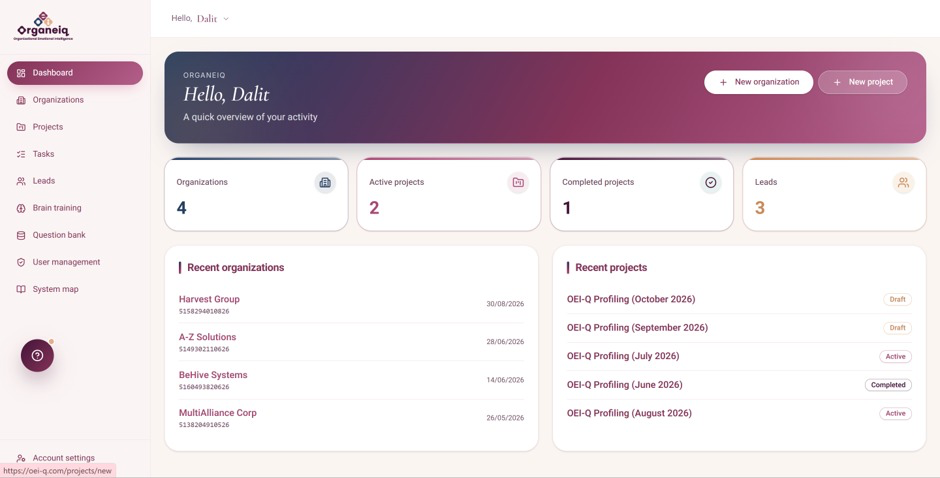
Your OEI work, all in one place.
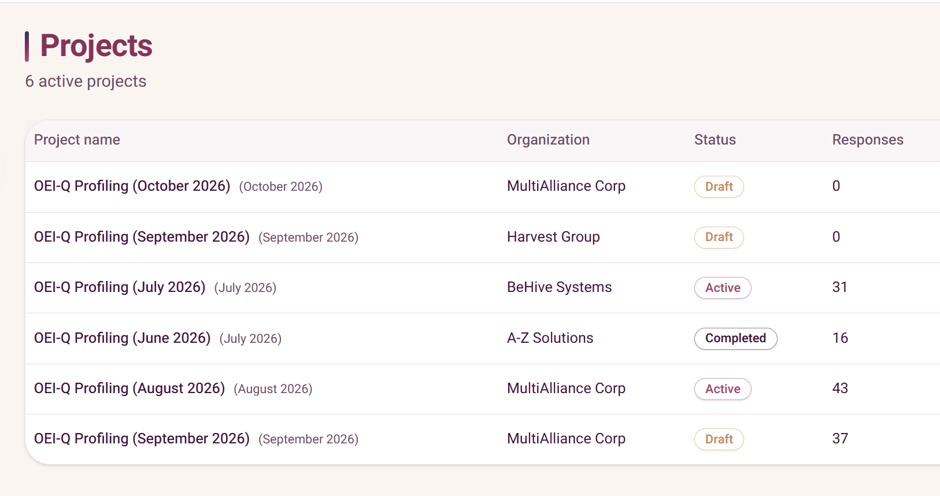
OEI-Q includes a dedicated workspace for organizational leaders and consultants to manage organizations, assessment projects and response progress. All in one place.
Organizations · Projects · Stakeholders · Response Tracking · Assessment Management
For organizations
Manage your organization’s OEI assessment and follow its progress.
For organizational consultants
Manage multiple organizations and OEI projects from one workspace.
Built-in OEI Advisor
OEI guidance, right where the work happens.
A built-in OEI Advisor helps leaders and consultants explore OEI questions, learn the language and principles of OEI, and think through how to apply them within the organization.
From understanding OEI to making it part of how the organization works.
OEI Advisor
How can we redesign our onboarding process through an OEI lens?
Let’s work through it together.
The OEI-Q
See it running on your own organization.
A short conversation is enough to tell whether the OEI-Q fits where you are right now.
Let’s Talk